Assignments

Want a Healthy Mind, There’s An App For That

Hi and welcome back to Keep Your Mind Healthy! 

In case you’re new here, make sure you check out my previous blog posts. In my blog post, Mind Matters I explain how mental and physical health are equally important components of one’s overall health. Let’s Be Mindful of Our Sources was written to give you a better idea of what sources can and can’t be trusted, and to remind you to always be mindful of the sites you visit and the information you are given in order to achieve good mental health. In Social Media On Your Mind I gave you some key internet safety tips to follow. And in my most recent blog post, Quashing Myths About Mental Health Problems I quashed myths about mental illness to help you form your opinion on mental health based on facts and not myths. Now in this post, I am going to list three applications that I find helpful for one’s mental health and believe are beneficial to those who are shy to seeking professional help, and can help them ease up to the idea of doing so. Let’s get started!

Moodpath

Price: Free

Developer:  MindDoc

Available for: Android and iOS12.0 or later on iPhone, iPad, and iPod touch.
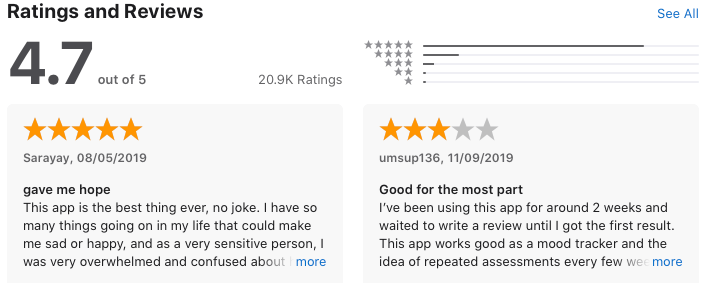
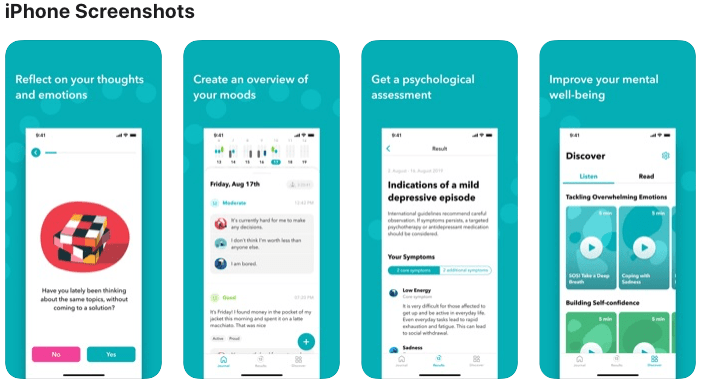
Moodpath, aka ‘your mental health companion,’ is the leading mental health app to guide you toward emotional well-being. It’s designed to help those struggling with depression or anxiety identify their mood on a day-to-day basis. Through this mobile app, users can get answers to their questions related to their emotional and physical well-being, track their thoughts in a mood journal, and can select mindfulness techniques from a library. Moodpath provides users with an evaluation every two weeks and gives them in a way a screening according to their symptoms. The user also has the choice to have the app generate a letter to a doctor, making the first consultation easier for both the patient and the doctor. This app seems to work for many people so make sure to check it out!
What’s Up

Price: Free

Developer: Jackson Tempra

Available for: iOS and  Android.
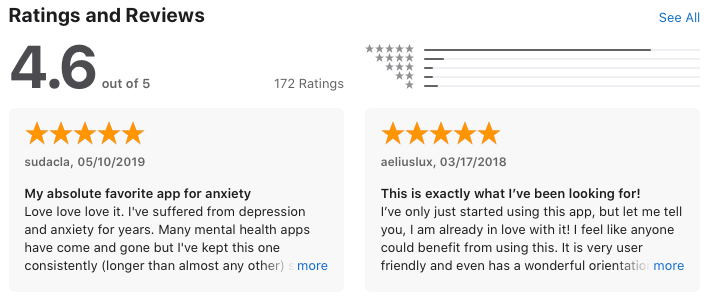
What’s Up is an app using Cognitive Behavioral Therapy and Acceptance Commitment Therapy, both evidence-based treatments for mental illnesses. It contains a positive and negative habit tracker to appreciate one’s good habits and acknowledge the counter-productive ones. Some more amazing features within this app are a journal paired with a feeling scale, breathing techniques, forums to connect with other, positive quotes and metaphors, as well as games to destress. The beauty of this app is that it caters to people of various disorders. So if you or someone you know are looking for methods to help cope with OCD, depression, anger, anxiety, or stress make sure to download this app!


Talkspace Online Therapy

Price: Free*

Developer: Groop Internet Platform inc.

Available for: iOS and Android
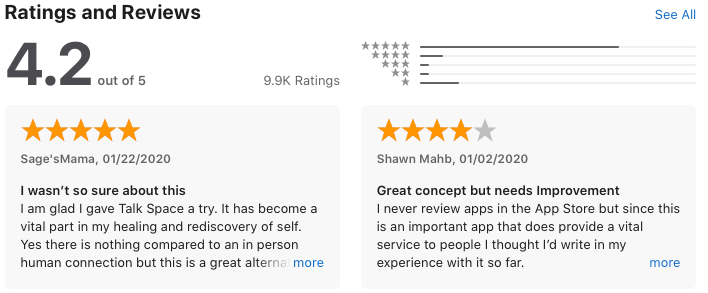
The app itself is free, however Talkspace is a subscription service, starting at only $65/week, cheaper than in-person therapy, which typically costs $150 for each weekly session. All plans come with unlimited messaging and you can even choose to add live video sessions. The app even offers unlimited messaging therapy to teens ages 13-17 and special services for couples therapy. You can change therapists or stop subscription renewal at any time. The app allows you to select your therapy preferences and matches you with a therapist in your state that same day. You can send your therapist unlimited text, audio, picture, or video messages from anywhere, at any time and you’re guaranteed to hear back at least once a day, 5 days per week. This app also lets you track your progress so you can see how you have been doing while working with your therapist. Talkspace is not hard to use and makes it easy to communicate, so give it a try today!

There are many other great apps out there available to you at low, if any cost that can fit into your lifestyle and help improve your mental and physical health. These three apps are a great place to start to see which techniques work for you and which don’t in order to help you improve your overall health. So start helping yourself or someone you know by directing them to these apps and telling them to download them now!

Until next time!
Disclosure: To be clear, the goal of this campaign is for health promotion purposes only. I am not seeking to gain profit from anyone.

Assignments

Quashing Myths About Mental Health Problems

Hey, welcome back to my blog! In case you’re new here, make sure you check out my previous blog posts. In my blog post, Mind Matters I explain how mental and physical health are equally important components of one’s overall health. Let’s Be Mindful of Our Sources was written to give you a better idea of what sources can and can’t be trusted, and to remind you to always be mindful of the sites you visit and the information you are given in order to achieve good mental health. In my most recent post, Social Media On Your Mind I give you some key internet safety tips to follow. In this blog post, I am going to be quashing myths about mental health problems to help you form your opinion on mental health based on facts and not myths.

MYTH #1: Mental health problems are not all that common.

FALSE. This can be very easy to believe if you yourself have never had any mental health issues or if you have never met anyone with mental health problems. However,  this statement is actually false! Surprisingly, according to MentalHealth.gov, one in five American adults experienced a mental health issue.

MYTH #2: People with mental health issues are violent, dangerous, and unsafe to the community.

FALSE. Sadly, many people do believe that people with illnesses are dangerous, but that is not always true. In fact, according to the American Public Health Association, most people who have mental health issues do not commit any crimes whatsoever. 

MYTH #3: Children don’t experience mental health problems.

FALSE. According to MentalHealth.gov, half of all mental disorders are shown before a child turns fourteen years old, and are clinically diagnosable. 

MYTH #4: Mental illnesses are not real medical problems. 

FALSE. I have already debunked this in a previous blog post. Mental health illnesses are real medical health problems with scientific facts to prove it. According to WebMD, mental disorders can be derived from abnormal nerve cell circuits (in the brain) that are not functioning properly, causing a disruption in neurotransmitters’ communication, leading to mental disorders. 

MYTH #5: I can’t do anything to help someone with a mental health problem.

FALSE. This is extremely untrue! If you know someone struggling, forming part of their support system is the best thing you can do. According to MentalHealth.gov, learning about the mental illness, researching ways to help, and letting the person know you are always there for them are great ways to help someone. 

MYTH #6: People with mental illnesses cannot hold a real job.

FALSE. According to the Mental Health of America Association, people with mental illness can work just as well as those without a mental illness, and their desire to be in a workforce is the same as everyone else’s. Just because a person has an illness, does not mean they’re incapable of working a normal everyday job.

MYTH #7: Mental health illnesses are contagious. 

FALSE. I’m sorry, but this one is a bit ridiculous. Mental health illnesses are not contagious since it’s an illness within one’s own brain that comes from a chemical imbalance, as I mentioned before. According to the Optimum Performance Institute, mental illnesses are not like the flu or a cold that people can catch from other people. 

MYTH #8 : People with mental health issues will never recover.

FALSE. This statement is not true at all. Even though mental health issues are hard to deal with, there are so many ways to help lessen the issues and may even permanently help. According to the Mental Health of America Association, recovery can be achieved through medication, therapy, and mindfulness along with others.

In order to help decrease the stigma surrounding mental illness, it’s important to debunk these myths and have some insight. Understanding these will essentially help us all become healthier individuals and better allies. And remember to check for credible sources, like those from the government, from large associations, or organizations that have .gov or .org in their hyperlink. For example, The National Alliance on Mental Illness (NAMI) has a list full of myths, as well as MentalHealth.gov that I encourage you to go check out. NAMI as I mentioned in my very first blog is one of the largest mental health organizations that focuses on education and advocacy. Their media presence includes Twitter, so I recommend you go follow them @NAMICommunicate

That’s it for today. See ya next time!

Assignments

Social Media On Your Mind

Hi, and welcome back to Keep Your Mind Healthy! In case you are new here, make sure you check out my previous blog posts. In my blog post, Mind Matters I explain how people hear the word “health,” and automatically think about illness or the physical aspect and completely leave out mental health. As I mentioned before, mental and physical health are equally important components of overall health. I wrote Let’s Be Mindful of Our Sources to give you a better idea of what sources should give you peace of mind due to their trustworthy and credible information when it comes to mental health and what sources you should never mind because what you read on those sources may or may not be credible. Remember to always be mindful of the sites you visit and the information you are given in order to achieve good mental health. This post aims to serve you by giving you some key internet safety tips to follow.

Who Else Is Tracking Your Mental Health

Now keeping all of that in mind, have you ever noticed that when you look something up on your phone, there will be an ad for it on your phone within the minutes? I know I have! Recently, I watched a Ted Talk by Jennifer Golbeck who talks about this phenomenon. Our electronic devices, especially our phones, have a way to track our information and study the things we look up. Ultimately, helping companies track our patterns and helping them with advertising.

This can be very creepy, especially when it comes to mental health searches. If someone who’s extremely vulnerable, is looking up their symptoms or medications in private, I’m sure the last thing they want is someone on the other side tracking their information to be able to advertise it to them later. I want you to remember that you have privacy settings that can allow you to control whether you want to see more or less content regarding mental health, regardless of the social media you use. However, if it puts your mind at ease you can also call a clinic or use a helpline as opposed to using the internet.

Social Media Accounts

Speaking of social media and the internet, I have some new social media accounts you should follow regarding mental health. I have a Vimeo account that focuses on mental health. So go check out that account to see how different aspects of life affect our mental health and what one can do to make sure they are mental healthy! I also have a Twitter account that I’m starting up called ClearMindz that will be a safe space to find aid and inspirational quotes. Follow me at @ClearMi43585646

Copyright

On the topic of social media, I recently watched a TED Talk by Lawrence Lessig named, The Laws that Choke Creativity. Lessig discusses laws that have been put in place to attempt to stop people from using another person’s work to be transformed into something else and the impact they can have on creators. There’s always going to be concerns regarding copyright and fair use of others’ ideas, art, and work posted online. After watching this video, I want to make sure my work is available to others to build on and learn from. Keeping that in mind, in order to protect my accounts, I will not use any material that is copyrighted nor will I plagiarize. Whenever I use other sources to reference data, I make sure to always link the website to the original creators and quote them in my blogs as well. And I encourage you to do the same. See you next time!

Disclosure

To be clear, the goal of this campaign is for health promotion purposes only. I am not seeking to gain profit from anyone.

Assignments

Let’s Be Mindful of Our Sources

In my last blog post, I explained how many people hear the word “health,” and automatically think about illness or the physical aspect and completely leave out mental health. Mental health is an important part of one’s overall health and well-being, encompassing our emotional, psychological, and social well-being. It affects how we think, feel, and act. It also helps determine how we handle stress, relate to others, and make healthy choices. As I mentioned before, mental and physical health are equally important components of overall health. I can not stress that enough. Now keeping all of that in mind, we all know how to type on our phone or on our computer “Mental Health,” and click on a link. However, how do we know that the page we are about to open up is credible or not? How do we know whether or not to follow their suggestions? How do we know that Instagram post is legit? What about that Facebook post? In order to help you figure out where to initially look when it comes to finding information on mental health and knowing what can be trusted, I have organized some sources into two categories, “Peace of Mind” and “Never Mind.”

Peace Of Mind

MentalHealth.gov

MentalHealth.gov is a site set up by the Department of Health and Human Services (HHS) that provides one-stop access to U.S. government mental health and mental health problems information. MentalHealth.gov aims to educate and guide the general public, policy makers, health and emergency preparedness professionals, leaders, school systems, and communities. This site is great for learning about mental health and the different types of illnesses and disorders, and helping find treatment and recovery.

National Institute of Mental Health (NIMH)

The National Institute of Mental Health (NIMH) is the lead federal agency for research on mental disorders. NIMH is also part of the U.S. Department of Health and Human Services (HHS). NIMH envisions a world in which mental illnesses are prevented and cured. They have a mission to transform the understanding and treatment of mental illnesses through basic and clinical research, paving the way for prevention, recovery, and cure. This site is extremely credible because all their information is based on research. NIMH is great for learning about mental health research, funding, finding treatment, and joining a study. 

Mental Health America

Mental Health America is the nation’s leading community-based nonprofit dedicated to addressing the needs of those living with mental illness and promoting overall mental health of all Americans. Aside from promoting mental health, they work on including prevention services for all; early identification and intervention for those at risk; integrated care, services, and support for those who need it; with recovery as the goal. I personally follow their Instagram account @mentalhealthamerica which provides insightful and positive posts and links you to blogs, screenings, and help.

Never Mind

NaturalNews.com 

NaturalNews.com was founded by Mike Adams, who claims to have cured his own type 2 diabetes with natural remedies. This site is one of many health-focused sites that peddle false and misleading claims to large audiences. This is done by presenting themselves as authoritative reference guides on health topics while relying on false claims and misrepresented sources to promote alternative medical treatments. This site is not at all credible.

Facebook 

Facebook is a place to connect with friends, family, and other people you know. We share photos and videos, send messages and get updates. Even though this is a great platform to communicate and share information, not everything posted is true. Many links shared can be fake, false and misleading information. There have been dozens of times where my friends on Facebook share a post that they’ve come across, I would read it only to realize it sounds insane. And many times it’s a scam, or someone just writing nonsense for attention (shares, comments, and reactions.)

Tune In

Tune In is a free internet radio. They deliver live sports, up-to-the-minute news, curated music, millions of podcasts, and over 120,000 streaming radio stations. Considering they have an audience of 75 million listeners, across 197 countries with an average listening time of 400 million hours monthly, one should realize that not all podcasts delivered through this platform can be reliable or credible. Podcasts are heavily opinionated, which makes them biased, therefore they become not-credible sources.

This post was written to give you a better idea of what sources should give you peace of mind due to their trustworthy and credible information when it comes to mental health and what sources you should never mind because what you read on those sources may or may not be credible. Always be mindful of the sites you visit and the information you are given in order to achieve good mental health.

Assignments

Mind Matters

When people hear the word “health,” they automatically think about illness or the physical aspect and completely leave out mental health. According to the World Health Organization (WHO), the definition of health is a state of complete physical, mental, and social well-being and not merely the absence of disease and infirmity. 

Many of you may ask yourselves, what is mental health? Mental health is an important part of one’s overall health and well-being. Mental health includes our emotional, psychological, and social well-being. It affects how we think, feel, and act. It also helps determine how we handle stress, relate to others, and make healthy choices. Mental health is important at every stage of life, from childhood and adolescence through adulthood. 

It’s important to remember that a person’s mental health can change over time, depending on many factors. There is no single cause for mental illness. When things in life become overwhelming, one’s mental health could be severely impacted. For example, early adverse life experiences, medical conditions, genes, drug and alcohol use, economic hardships, caring for ill relatives, and feeling lonely or isolated may cause someone to experience poor mental health.

Poor mental health is more common than we believe. According to the National Alliance on Mental Health, more than 50% will be diagnosed with a mental illness or disorder at some point in their lifetime.1 in 5 Americans will experience a mental illness in a given year and 1 in 25 Americans lives with a serious mental illness, such as schizophrenia, bipolar disorder, or major depression. 1 in 5 children, either currently or at some point during their life, have had a seriously devitalizing mental illness.

As I mentioned before, mental and physical health are equally important components of overall health. Mental illness, mainly depression, increases the risk for many types of physical health problems, explicitly long-lasting conditions like diabetes, stroke, and heart disease. For this reason we must take care of our minds just as much as our bodies.

According to WHO, there is a need to allocate resources and provide adequate training to the General Physicians about mental health and incorporate mental health care at primary level. The educational awareness needs to be spread among masses to reduce stigma associated with disclosure of mental illness.

In order to maintain good mental health, you must value yourself by treating yourself with kindness and respect, and avoid self-criticism. You must make time for yourself and your hobbies. Taking care of your body is essential as well. You should eat nutritious meals, drink water, avoid drug use, exercise, and get enough sleep! Exercise helps decrease depression and anxiety and improve moods. Researchers believe that lack of sleep contributes to a high rate of depression in college students. You should make sure to have good connections with people and have someone to talk to, especially about your thoughts, emotions, and feelings. And lastly, don’t be afraid to get help if and when you need it. Remember you are not alone!

Additional Resources:

Substance Abuse & Mental Health Services Administration (SAMHSA) National Helpline (1-800-662-HELP (4357)

OK2Talk Helpline Teen Helpline 1 (800) 273-TALK

Crisis Text Line Text SIGNS to 741741 for 24/7, anonymous, free crisis counseling

Suicide Prevention Lifeline 1-800-273-8255

Veterans Crisis Line 1-800-273-8255